Informative Guide for Communication Method of Ultrasonic Water Meters: LoRaWAN, NB-IoT, or 4G
The global transition toward smart water management has accelerated the deployment of modern, digital utility networks. Central to this evolution is the replacement of aging mechanical meters with highly precise ultrasonic water meters. Operating without moving parts, these advanced units prevent mechanical wear, provide high turn-down ratios, and maintain exceptional measurement stability throughout their entire lifespan. However, capturing the true value of a digital system relies entirely on how its data is transmitted. Choosing an mismatched network protocol can quickly offset the structural advantages of digital hardware.
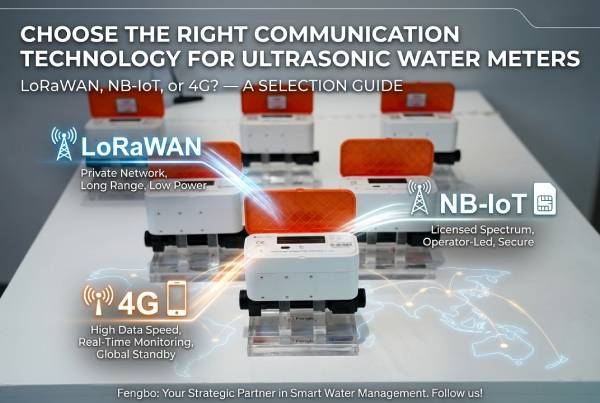
To establish a future-proof Advanced Metering Infrastructure (AMI), utility managers, engineers, and municipal buyers must weigh the technical tradeoffs between three dominant Internet of Things (IoT) communication frameworks: LoRaWAN, NB-IoT, and 4G cellular networks. This guide provides a systematic breakdown of each protocol to help you select the ideal connectivity architecture for your operational terrain.
1. LoRaWAN: Low-Power, Private Network Autonomy
LoRaWAN (Long Range Wide Area Network) is a non-cellular, license-free Low-Power Wide Area Network (LPWAN) specification designed specifically for battery-operated wireless assets. It operates on sub-GHz industrial, scientific, and medical (ISM) bands (such as EU868, US915, and AU915).
Key Advantages:
Zero Data Subscription Costs: Because LoRaWAN operates on open, license-free frequencies, utilities can deploy private base stations (gateways) to collect and manage their own data traffic, completely bypassing recurring telecom carrier monthly charges.
Exceptional Deep-Structure Penetration: The lower operating frequencies allow the wireless signal to penetrate deep architectural barriers, making it highly effective for deep underground utility pits, basement installations, or densely packed urban concrete structures.
Maximum Battery Longevity: Designed for brief, asynchronous uplink bursts, LoRaWAN minimizes transceiver power draw, allowing smart water meters to comfortably hit a 8-10-year field deployment lifecycle on internal batteries.
Primary Trade-Offs:
LoRaWAN functions on a shared spectrum, meaning payload sizes are small and transmission intervals must be throttled to maintain local regulatory duty cycles. It is built for targeted daily data alerts or hourly summaries rather than constant, real-time data streaming or high-frequency remote valve interventions.
2. NB-IoT: Dedicated Telecom Infrastructure for Enterprise Scale
NB-IoT (Narrowband Internet of Things) is a cellular LPWAN technology developed by the 3GPP as part of the LTE ecosystem. Operating within licensed spectrum bands, it leverages existing mobile network towers to connect thousands of IoT endpoints securely per cell site.
Key Advantages:
Carrier-Grade Quality of Service (QoS): Running on a licensed cellular spectrum means NB-IoT networks are completely insulated from the signal collisions, interference, or civilian cross-talk that can impact un-licensed bands.
No Local Infrastructure Overhead: Utilities do not need to install, maintain, or secure physical gateways. The water meters connect directly to existing cellular network towers right out of the box.
Massive Node Density: NB-IoT cellular sectors are engineered to handle over 50,000 connections simultaneously per base station, guaranteeing scalable, reliable data collection in highly populated residential zones.
Primary Trade-Offs:
Deploying NB-IoT entails recurring data SIM subscription costs with national telecom operators. Furthermore, network availability depends strictly on commercial carrier coverage maps; if a utility site sits in a remote or rural zone lacking NB-IoT tower deployment, connection is impossible without carrier infrastructure expansion.
3. 4G LTE: High-Bandwidth and Real-Time Operational Control
Traditional 4G (including LTE-M / Cat-1 variations) represents standard, high-speed cellular connectivity. While generally optimized for high-throughput mobile data, it serves a critical niche in complex, large-scale industrial water infrastructure.
Key Advantages:
Blazing-Fast Data Speeds & Low Latency: 4G delivers immediate, bidirectional communication. This allows for near-instantaneous transmission of dense telemetry profiles, immediate over-the-air firmware updates (FOTA), and instantaneous prompt responses for automated emergency tasks.
Ubiquitous Global Footprint: 4G cellular infrastructure is mature and highly pervasive globally, offering stable, high-performance coverage across urban, commercial, and suburban districts.
Primary Trade-Offs:
High bandwidth demands intense power profiles. Continuous 4G modems exhaust standard internal batteries rapidly, making them poorly suited for isolated residential units. Consequently, 4G communication is reserved primarily for main distribution lines, bulk district metered areas (DMAs), or industrial sites where external mains power lines are easily accessible.
| Operational Metric | LoRaWAN | NB-IoT | 4G LTE / Cat-1 |
| Spectrum Type | Unlicensed (Sub-GHz ISM) | Licensed Cellular Band | Licensed Cellular Band |
| Infrastructure Setup | User-deployed gateways required | Direct to carrier towers | Direct to carrier towers |
| Data Payload Capacity | Very Low (Up to 242 bytes) | Low / Medium (Up to 1600 bytes) | High (Uncapped for meters) |
| Power Performance | Ultra-low (8-10 year battery) | Low (8-10+ year battery) | High (External / Main power best) |
| Recurring Operational Cost | None (Internal network management) | Low (Carrier SIM subscriptions) | Moderate to High (Cellular plans) |
| Best Application Scenario | Private industrial sites, rural pits | Smart city residential deployment | Bulk DMAs, industrial mainlines |
In Conclusion
The above is an analysis of the advantages of three common communication methods for smart water meters; however, the final choice should be based on a comprehensive assessment of your specific circumstances. If you are looking for a suitable ultrasonic water meter solution, please feel free to contact us. As a reliable Chinese manufacturer and supplier of ultrasonic water meters, we offer complete solutions—including both the meters and management systems—tailored to your specific needs and operational requirements.
* Email: [email protected]
* Whatsapp: +86 19337882352
Previous:
Next: